 Sun Ninja Hand Pump for Paddle Board, Inflatable Hammock and Floating Chair
 $18.89 View on Amazon
Calculator
Quick answerA 10'6" x 33" x 6" board holds about 295 litres. Reaching 15 PSI takes about 595 litres of free air: roughly 425 strokes and 9 minutes on a single-action hand pump, or 8 to 9 minutes on a 12-volt electric pump.
Do not leave a fully inflated board on hot sand or a car roof in direct sun. Let a little air out, or store it in shade.
The last 3 PSI take about a third of the effort. Switch a double-action pump to single-action mode above 7 PSI.
Cards re-sort as you change the inputs: the ones that meet your numbers move to the front. Check each listing's rated capacity and dimensions before buying.
Sun Ninja Hand Pump for Paddle Board, Inflatable Hammock and Floating Chair  BAVIZZN Paddle Board Pump, Electric SUP Pump for Paddle Board Inflatables (Orange) 22 PSI
  Aoiiefe Paddle Board Pump, 13500mAh Rechargeable 20PSI Portable Paddle Board Electric Pump, USB-C SUP Air Pump, Intelligent Dual Stage Inflation Deflation, Auto-Off 20 PSI
 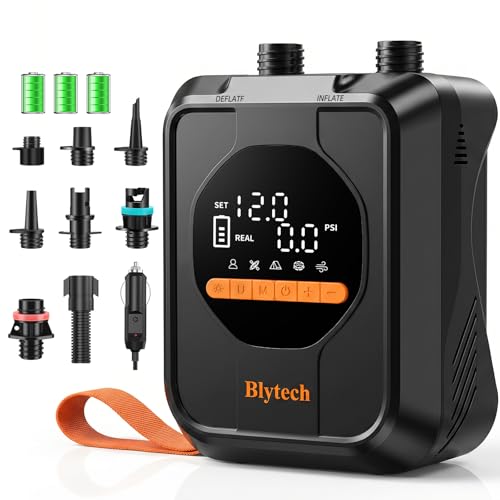 Electric Paddle Board Pump, Portable 20PSI SUP Air Pump with 13,500mAh Rechargeable Battery, Fast Inflation/Deflation, 7 Nozzles for Kayaks, Boats, Tents, and Inflatables (Black) 20 PSI
  OutdoorMaster Shark 2 High Pressure SUP Pump, Electric Air Pump 20 PSI 20 PSI
  OutdoorMaster Shark 3 Mini 74Wh Portable Paddle Board Pump Electric 15 PSI
 board volume = L x W x T x 0.72 | free air = volume x (1 + PSI / 14.7) | strokes = free air / litres per stroke | heat rise: P2 = (P1 + 14.7) x T2 / T1 - 14.7
The 0.72 shape factor accounts for the tapered nose and tail. Stroke volumes are effective averages across the whole fill; the last few PSI take most of the effort. Estimates, not a pump test.
An inflatable board is a sealed box of air. The calculator estimates that volume from the dimensions (with a 0.72 factor for the tapered nose and tail), then works out how much free air you have to push in to reach the target pressure: volume x (1 + PSI / 14.7). Dividing by the effective litres per stroke gives strokes and minutes.
It also runs Gay-Lussac's law for heat. Air pressure rises with absolute temperature, so a board pumped to 15 PSI and left to warm by 25 F in the sun gains roughly a PSI. That is why makers say to let a little air out on hot days.
| Scenario | Result | Board air volume | Free air to pump in |
|---|---|---|---|
| 10'6" x 33" x 6", hand pump | 9 minutes | 294 L | 595 L |
| 10'6" x 33" x 6", electric | 8 minutes | 294 L | 595 L |
| 11'6" x 35" x 6", double action | 9 minutes | 342 L | 691 L |
| 12'6" x 32" x 6", 18 PSI | 12 minutes | 340 L | 756 L |
| Kids 8' x 30" x 6", 12 PSI | 6 minutes | 204 L | 370 L |
Roughly 350 to 500 strokes with a single-action hand pump for a 10'6" board to 15 PSI, depending on board size and pump. Double-action pumps cut the early strokes; switch to single action above about 7 PSI when it gets hard.
For one board, a hand pump takes about as long and costs less. Electric pumps win for families inflating two or more boards, for riders who want 18 to 20 PSI, and for anyone with shoulder trouble. They run off the car's 12 volt socket or a battery.
Yes. Stay at or below the maximum printed by the valve, usually 15 to 20 PSI. Overpressure can split seams, and heat adds pressure on its own, so never leave a board pumped to the maximum on hot sand or a car roof.
On the water: Wear a properly fitted, USCG-approved life jacket every time, dress for the water temperature rather than the air, and check your state and local paddling regulations before you launch.
This is researched general information, not professional advice. Sizing figures are starting points: confirm against the maker's own sizing chart and the capacity printed on the boat or board.