 Inflatable Kayak for 2 People with Detachable Canopy, Reinforced Paddles 2-person
 $99.97 View on Amazon
Sizing specs: Inflatable Kayak for 2 People with... Guides
Quick answerA kayak's true safe load is about 70 percent of its printed weight capacity, so a 200 lb paddler with 25 lb of gear should look for a rating near 325 lb, which is why a roomy tandem like the Intex Explorer K2 rated to 400 lb is a common recommendation for a solo paddler who wants margin.
A kayak's weight capacity is not the weight you should actually load into it. The printed number is closer to the point where the boat becomes dangerous, so the usable, comfortable number is about 70 percent of that rating. A 250 lb paddler with 25 lb of gear needs a boat rated near 395 lb, which rules out most budget solo kayaks and points toward wider or tandem-rated hulls like the best kayaks for heavier paddlers.
The weight capacity printed on a kayak's spec sheet is the maximum combined load, meaning the paddler, any passenger, and all gear, before the hull sits so low that freeboard (the dry hull above the waterline) nearly disappears. At that maximum, the kayak is slow, hard to turn, and takes on water over the sides in any wind or wake. Manufacturers rate to that maximum because it is a real physical limit, not because it is a comfortable place to paddle.
Take your body weight, add your passenger if any, add roughly 20 to 30 lb for a cooler, dry bag, paddle and life jacket, then divide by 0.7. That is the rated capacity you should be shopping for. The table below runs the math for common paddler weights.
| Paddler weight (with about 25 lb gear) | Required capacity rating | Load percentage if you buy exactly that rating |
|---|---|---|
| 150 lb | 255 lb | ~70 percent |
| 200 lb | 325 lb | ~70 percent |
| 250 lb | 395 lb | ~70 percent |
| 300 lb | 465 lb | ~70 percent |
Buying at exactly that required rating puts you right at the 70 percent line, which is the target, not the ceiling. If you can size up further, do it.
Anywhere from 70 to 85 percent of rated capacity, a kayak gets sluggish and low in the water but is still generally fine on calm, flat water. Past 85 percent, freeboard drops enough that wind, boat wake or any chop can put water over the sides, and the boat becomes genuinely hard to control. Treat 85 percent as a hard ceiling, not a target, and never load to 100 percent of the printed rating.
Wider inflatable hulls often carry surprisingly high capacity ratings for the price, since a wide, flat-bottomed inflatable displaces more water per foot of length than a narrow hard shell. Some real examples across both categories:
| Kayak | Rated capacity | Usable load (70 percent) | Best for |
|---|---|---|---|
| WONITAGO inflatable | 330 lb | ~230 lb | One light solo paddler on a budget |
| Pelican Argo 100X EXO (hard shell) | 275 lb | ~190 lb | One lighter paddler who wants a hard hull |
| Intex Explorer K2 (inflatable) | 400 lb | ~280 lb | Solo paddler with gear, or two light kids |
| Niphean 12'6" tandem (inflatable) | 500 lb | ~350 lb | Two average-size adults |
| Perception Rambler 13'6" (hard shell tandem) | 550 lb | ~385 lb | Two adults, touring or all-day trips |
Notice how the hard-shell solo kayaks rate lower than similarly priced inflatables. That is a real tradeoff for the tracking and speed a hard hull gives you, not a manufacturing shortcut, and it is exactly why heavier solo paddlers often end up happier on a wide inflatable or a tandem hull paddled solo.
An even spread across the price range, cheapest to premium. Prices at last check.
Inflatable Kayak for 2 People with Detachable Canopy, Reinforced Paddles 2-person  INTEX Explorer Kayak 2-Person Portable Set w/Paddles & Pump, 2-Pack 10'4" / 400 lb max / 2-person
  Aqua Marina Tomahawk Air-K Inflatable Touring Kayak, 1 Person, 12 Ft 4 In 12'4" / 1-person
 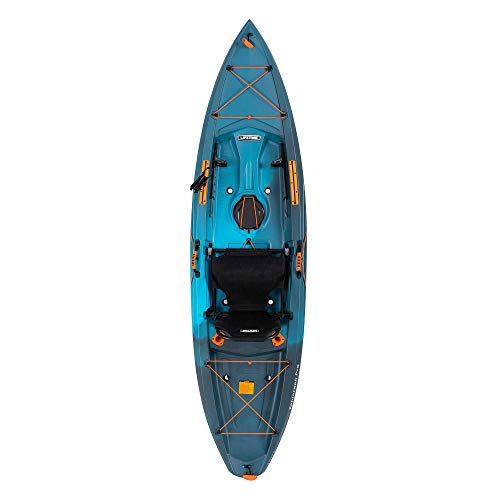 Lifetime Tamarack Pro 103 Sit-On-Top Kayak, Lightning Fusion, 10 ft. 3 in. 10'
  Perception Kayaks - 13.5 Tandem Kayak - Sit on Top - Large Rear Storage with Tie Downs - 13.5 ft - Deja Vu 13'6" / 500 lb max / 2-person
  Oru Haven Foldable Kayak | for 1 or 2 People - Stable, Durable, Lightweight - Lake and River Kayaks - Beginner, Intermediate - Size (Unfolded): 16'1" x 33", Weight: 41 Lbs, Black 16'1" / 2-person
 Add your body weight, any passenger, and about 25 lb of gear, then divide by 0.7. A 200 lb solo paddler needs a kayak rated near 325 lb. Buying right at that number puts your typical load at about 70 percent capacity, which is the comfortable, stable target rather than the maximum.
It is the maximum combined weight of paddler, passenger and gear before the hull sits low enough to lose stability and take on water. It is a hard ceiling, not a comfortable operating point, which is why the working rule is to load to no more than about 70 to 85 percent of that number.
The hull rides low, freeboard shrinks, and the boat becomes slow, hard to turn and prone to taking water over the sides. Past roughly 85 percent of rated capacity, this becomes a real safety issue in any wind, wake or chop, not just a performance annoyance.
Not automatically. A higher-rated kayak is usually wider or longer, which adds stability and load room but can also add weight, making it slower to paddle and heavier to carry. Match the rating to your actual needs using the 70 percent rule rather than buying the highest number available.
Often the opposite for a given price point. A wide inflatable hull displaces a lot of water for its length, so budget inflatables frequently carry higher capacity ratings than similarly priced hard-shell solo kayaks, though hard shells generally track straighter and paddle faster.
Recreational solo kayaks, both inflatable and hard shell, commonly rate between 220 and 400 lb, with tandem kayaks built for two paddlers rating from about 400 to 550 lb. Check the specific model rather than assuming an average applies to your boat.
On the water: Wear a properly fitted, USCG-approved life jacket every time, dress for the water temperature rather than the air, and check your state and local paddling regulations before you launch.
This is researched general information, not professional advice. Sizing figures are starting points: confirm against the maker's own sizing chart and the capacity printed on the boat or board.